When Grief Doesn't Look the Way You Expected...A Letter From Inside It

I'm writing this a few days after losing my brother.
I'm writing it because I don't fully understand what I'm feeling yet, and I think that's exactly why I need to write it.
My brother was younger than me by five years. And for most of our adult lives, we lived on opposite sides of the world. He stayed in Canada. I built my life in Australia. Twenty
years of distance, of calls and messages, of loving someone across an ocean. And yet the moment I heard he was gone, the distance collapsed completely. He was suddenly everywhere, in my chest, in my throat, in every quiet moment when my mind went still.
That's the strange and surreal nature of grief. It doesn't care about kilometres.
His Life Was Not an Easy One
My brother served in the army when he was young. And like so many who do, he came home carrying something invisible and unbearable, PTSD that never fully left him. His body had been through things most people couldn't imagine. Car accidents. Falls. Surgeries. Rebuilt and broken and rebuilt again, over and over. He was in constant pain, heavily medicated, living in a body that felt more like a prison than a home.
If I'm honest, and I want to be honest here, because honesty is the only thing that feels right right now, my brother had wanted to die for a long time. He wasn't living. He was surviving. Waiting. And as heartbreaking as that is to say out loud, there is a strange, quiet relief sitting underneath my sadness. A feeling that he is finally free. Free from the pain. Free from the dark thoughts that never stopped chasing him. Free from a body that had been destroyed and stitched back together so many times it had forgotten what ease felt like...
His death was a shock. And it wasn't.
Both things are true. And I'm learning that grief is full of contradictions like that.
The Thoughts That Come Flooding In
What nobody tells you about losing someone is the thoughts.
Not just the sadness, though the sadness is enormous, the kind I had never felt before in my body. A sadness so deep and physical I finally understood the phrase dying of a broken heart. The pain is real. It lives in the chest. It catches you mid-breath.
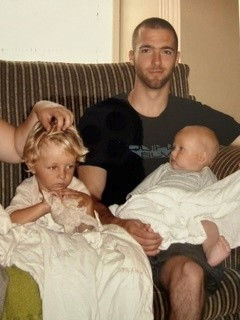
But alongside the sadness comes this flood of everything. Every memory. Every version of him you've ever held. I remember him as a baby. I remember dressing him up, yes, as a girl, because I was five and I thought it was hilarious and he was the best little sport about it. I remember the games, the laughter, his quirks, the way he smiled.
I remember his wedding. His daughter. The army and how it changed him, that particular kind of change that takes someone and returns them altered in ways that are hard to name.
And then come the thoughts you didn't ask for. The what ifs. The I should haves. The maybe if I had just... The replaying of every moment you wish you'd done differently, every time you weren't the sister you wanted to be, every phone call you let go too long.
Guilt. Grief always brings guilt. Even when you have no good reason for it, and sometimes even when you do. It comes anyway.
This is normal, any feelings are totally valid and I want you to know that. If you're sitting in your own grief right now reading this, those spiralling thoughts, that guilt, that anger, that confusion, it is normal. You are not broken. You are human. And you are loving someone through the only door that's still open.
Identity Shifts the Moment Someone Dies
There's something nobody prepares you for, the way loss changes who you are.
In one moment, without warning, the sentence changes. From I have a brother to I had a brother. And that shift, that tiny grammatical shift, is enormous.
Because part of your identity has always been built on who you are in relation to this person. And now you have to learn who you are without them. Not without their love, not without their memory, but without the living, breathing version of them.
It's disorienting. Surreal. Like the ground has moved and you're not quite sure where to put your feet.
He Was a Projector, in HD And That Finally Makes Sense
I know Human Design. It's part of how I work with my clients. And I found myself going back to his chart after he passed, wanting to understand him more fully, the way you look for meaning in everything when someone is gone.
He was a Projector. Splenic authority. A 6/2 — the Role Model and the Hermit. Single definition, with only his Spleen and his Heart/Ego defined.
Suddenly so much made sense.
The Projector is not designed for a world that runs on constant energy and hustle. And the army, with its relentless demands, its culture of push and endure, was perhaps the most mis-aligned environment imaginable for someone built the way he was.
Projectors need to be recognised and invited. They need space, rest, and depth. They are wise beyond measure, and they burn out fast when no one sees them.
His Splenic Authority meant he operated on instinct. In the now. A whisper of knowing that lived in the body. And his body, by the end, had been through so much that I wonder if his Spleen had been quietly communicating for years, it's time to rest now. It's time to be free.
His 6/2 profile — the Role Model and the Hermit — meant he was here to live authentically, even when that was painful. He was not here for the easy path. He was here for the full human experience, in all its messiness and beauty and struggle. And his Channel of Initiation and Surrender... even in the name, there is poetry. He initiated. He endured. And eventually, he surrendered...
I believe he is finally at peace. And I believe...truly, deeply...that the way he lived, even through all that darkness, meant something.
He's Closer Now...
Here's something I didn't expect, and I share this not to tell you what to believe, but to share what has brought me comfort in these strange first days.
I feel him more now than I have in years.
It's not logical. But grief isn't logical, and neither is love. There's a closeness now that the distance of geography always made harder. I can talk to him. I feel him near me. And rather than making the grief heavier, it makes it lighter, a strange comfort, like finding out someone who moved away has actually been living next door all along.
If you feel something like this, some sense of continued connection with someone that has transition, please don't dismiss it. It might be exactly what you need...
I'm not on the other side of this yet. I want to be honest about that. I don't have a tidy bow to tie at the end.
But here's what I know, even from inside it:
Feel everything. The sadness. The guilt. The anger. The relief. The love. The confusion. Don't manage it or rush it or try to feel only the socially acceptable parts of grief. It's all valid. It's all part of loving someone.
The thoughts will come in waves. And the waves will get further apart. Not today, maybe not for a while, but they will...
You are allowed to feel relief and grief at the same time. Those two things can coexist. Relief that someone is no longer suffering is not a betrayal of your love. It is an extension of it...
Let the memories in. Even the hard ones. Even the ones where you weren't your best self. They are proof that you loved a real person, not a perfect one.
And if you feel them close, talk to them. There is no wrong way to grieve.
Losing my brother has changed me. That much I already know. Part of my identity has been rewritten, and I'm still learning what the new sentence says...
But I also know this: he is no longer in pain. And that is, quietly, everything.
Rest now, little one. You've earned it.
If you're navigating grief right now, you don't have to do it alone. Whether through kinesiology, coaching, or simply having someone hold space for you, reach out. Healing is not a straight line, but you don't have to walk it by yourself.
Big love
Em


Comments